Aescap Genetics invests in the shares of publicly listed genetics biotech / life sciences companies. It invests in highly innovative companies that develop and market new genetics medical treatments such as gene, RNA and cell therapies. It can to a limited extent also invest in companies that develop and market medical genetics diagnostics. The companies are active in the concept of precision medicine. The concept of precision medicine is based on the fact that people respond differently to the same treatment. Based on gene profiling and biomarker data a patient can be given the right treatment from the start.
Aescap Genetics will typically construct a focused portfolio, investing in approximately 18 companies with the potential to (more than) double their share price over a period of maximum 4-5 years. It aims to make investments in companies located globally, but most investments are likely to be made in companies located in Europe and Northern America given the innovation power in biotech in these markets.
Initial publication date: 26 September 2024 (last update: 29 January 2026)
Summary
Aescap Genetics (the Fund) aims to create value by investing in publicly traded shares of genetics biotechnology and life sciences companies. The Fund invests in highly innovative companies that develop and market new genetic medical treatments such as gene, RNA and cell therapies. The Fund can, to a limited extent, also invest in companies that develop and market medical genetic diagnostics. The Fund’s objective is to achieve an average minimum annual net return (after deduction of costs) of >20 percent over 4-5 years. The Fund will typically invest in companies with the potential to (more than) double their share price over the same period.
Next to the objective of creating a financial return for investors, the Fund also promotes a social characteristic and is therefore classified under article 8 of the Sustainable Finance Disclosure Regulation (SFDR). The main focus of the Fund’s investments is in researching, developing, or producing treatment/solutions for diseases with a high unmet medical need. A high unmet medical need has been defined as diseases that are characterized by an (inadequacy of) available treatments, which severely impact the patient and the healthcare system, prevalent in the geographies the company currently markets or plans to market or distribute its current or future product(s).
The Fund aims to construct a portfolio of approximately eighteen companies that contribute to the social characteristic, and of which a minimum proportion of 30 percent (of the invested capital of the Fund) are considered sustainable investment. Invested capital consists of the Fund’s assets, excluding cash.
Next to establishing which sustainability risks are considered material for each investee company based on the Sustainability Accounting Standards Board (SASB), the Fund also analyses the investee companies’ preparedness to these sustainability risks as part of its due diligence process. The Fund takes the Principal Adverse Impact (PAI) indicators into account to determine if an investment can be considered sustainable. It investigates the processes and policies of any potential investment on environmental and social risks in the biotechnology sector as defined by the SASB and by the PAI indicators.
Monitoring of investee companies regarding their Environmental, Social and Governance (ESG) performance takes place monthly based on sustainability risks, investment allocation towards the social characteristic and the proportion of the investments determined as sustainable.
The Fund engages with investee companies to improve their ESG performance. Engagement can consist of meetings with management, data requests to investor relations to improve the policies and practices, or formal shareholder voting when considered necessary.
The Fund reports on a monthly and quarterly basis with updates on the financial returns. The Fund publishes an annual PAI report highlighting the engagement activities as well as any changes in policies and practices of the investee companies.
No sustainable investment objective
The Fund, promotes a social characteristic but does not have a sustainable investment objective. The Fund aims to have a minimum proportion of 30 percent of sustainable investments that contribute to the social characteristic.
-
The Fund will, in determining the 30 percent proportion of sustainable investments, take the PAI indicators into account. It investigates the processes and policies of any potential investment on environmental and social issues in the biotechnology sector as defined by the SASB and by the PAI indicators. The ESG risks that are material to the Fund’s investments are outlined in detail on the Fund manager’s website. In addition, the Fund excludes potential investments with a history of poor performance on sector best practices or that have insufficient policies or plans to improve in their social and environmental impact. The fund has prioritized the PAI indicators into ’very important’ and ’important’, respectively, based on their relevancy to the biotechnology sector and the specific areas where a company is most likely to do significant harm. Two of the mandatory PAI indicators are not deemed relevant for the companies within the investment scope of the Fund. The Fund’s PAI statement, available on the Fund manager’s website, contains a detailed explanation of the PAIs considered. If the Fund deems an investment is at risk of having a negative impact on or doing significant harm on more than one of the ‘very important’ indicators or on five or more of the ‘important’ indicators, then the investment cannot be considered sustainable. However, it may still contribute to the Fund’s social characteristic.
-
Each potential investment analysis includes a scan for violations of the OECD Guidelines for Multinational Enterprises and the UN Guiding Principles on Business and Human Rights for processes and compliance mechanisms that each investment needs to have.
More details can be found in the PAI Report and the SFDR Pre-Contractual Disclosure (Annex II).
Environmental or social characteristics of the financial product
In addition to the Fund’s financial objective to create value by investing in publicly traded shares of biopharmaceutical, diagnostics and/or medical device companies, it also promotes a social characteristic. The social characteristic promoted by the Fund consists of the research, development, or production of treatments or solutions for diseases with a high unmet medical need. A high unmet medical need is defined as diseases that are characterized by an (inadequacy of) available treatments, which severely impact the patient and the healthcare system, prevalent in the geographies the investee company currently markets or plans to market or distribute its current or future product(s). Examples are Alzheimer’s disease, arthrosis, diabetes, multiple sclerosis, cancer and Parkinson’s disease.
The Fund acknowledges the importance of a diverse mix of employees as well as strong corporate controls to develop treatments that work for all patients while maintaining the best working conditions and the highest quality levels in their processes. Therefore, the Fund considers and reports on the gender equality in investee companies’ Boards as well as their internal whistleblower policies.
By reporting on the number of female-identifying Board members and engaging with investee companies to collect this information alongside other employee engagement and diversity information, the sector is encouraged to improve its hiring practices and ultimately benefit from having diverse teams. In addition, by reporting on the level of whistleblower policies and engaging with investee companies to collect this information, the sector is encouraged to foster the best working conditions and the highest quality levels in their medical treatment development processes.
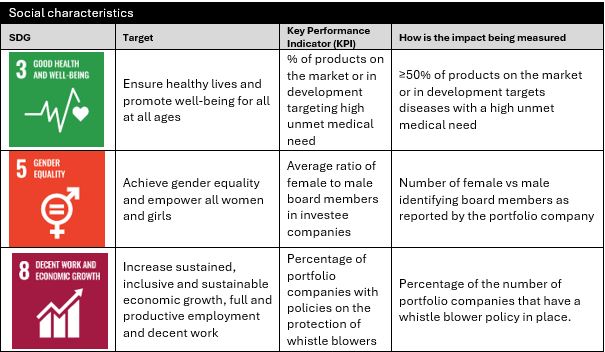
More details in the Pre-Contractual Disclosure Document (Annex II)
Investment strategy
The Fund invests in shares of publicly listed genetics biotechnology and life sciences companies. It invests in highly innovative companies that develop and market new genetic medical treatments such as gene, RNA and cell therapies. It can, to a limited extent, also invest in companies that develop and market medical genetics diagnostics. The investee companies are active in the concept of precision medicine. Based on gene profiling and biomarker data a patient can be given the treatment that works best for them specifically. Investee companies can also contribute to the Fund’s social characteristic, namely investing in companies researching, developing, or producing treatment/solutions for diseases with a high unmet medical need.
The Fund has a concentrated portfolio, investing in approximately eighteen companies with the potential to (more than) double their share price over a period of 4-5 years. It aims to make investments in companies globally, but most investments are likely to be made in companies located in Europe and North America given the innovative power of biotech in these markets.
The Fund’s investment team has a deep knowledge of the biotechnology sector and the ability to understand investee companies from both a financial and ESG perspective. The ESG evaluation is used to determine the potential investee company’s preparedness to deal with material ESG risks identified by SASB. If a potential investee company is found to have a low average preparedness on any of the material ESG risks identified, the Fund may include the investment in its portfolio and start an engagement project to improve its preparedness.
More details can be found in the Fund’s prospectus.
Proportion of investments
The Fund aims to align as much of its portfolio as possible with its social characteristic and targets a minimum of 30 percent of the Fund’s invested capital. The Fund’s investments may consist of:
- Listed shares of biopharmaceutical companies and potentially also diagnostics and/or medical device companies.
- Warrants of such companies. Often these warrants are received as part of an equity issue by a company.
Other Fund holdings may be:
- Cash: the Fund may hold cash freely available for investment or for portfolio management purposes.
- Borrowings: the Fund may temporarily borrow (no longer than one month) up to 10 percent of its Net Asset Value (NAV) for portfolio management purposes or to benefit from an investment opportunity.
- Non-aligned assets: holdings whose activities do not contribute to the social characteristic of the Fund. For non-aligned assets, at minimum a material ESG risk analysis based on the SASB is performed.
More details can be found in the Fund’s prospectus.
Monitoring of environmental or social characteristics
The Fund has determined that an investment that contributes to the Fund’s promotion of the social characteristic needs to be an investment that is researching, developing, or producing treatment for diseases with a high unmet medical need. The Fund will analyse per investee company what percentage of their activities is related to the research, development or production of drugs for diseases with high unmet medical need.
The Fund monitors the attainment of the social characteristic through:
- monthly monitoring of investment allocation towards the Fund’s social characteristic with the percentage of investee companies researching, developing or producing treatment for diseases with a high unmet medical need;
- monthly monitoring of the Fund’s exposure to sustainability risks that are reviewed and discussed in the monthly meetings;
- continuous monitoring of progress on ESG best-practice engagement.
The Fund reports the attainment of the social characteristic it promotes:
- annually on the percentage of investee companies researching, developing, or producing treatment for diseases with a high unmet medical need;
- annually on the engagement priorities with investee companies using the findings from the ESG material risk analysis and the ‘Do No Significant Harm’ (DNSH) analysis.
The companies the Fund invests in should not only have strong financials, good management and comply with the regulations, but they should also continue to improve their ESG performance wherever possible. The portfolio manager of the Fund has a long history of investing in and engaging with biotech companies. Engagement with small-cap companies can be very effective and can have a concrete and direct impact on their policies and practices.
More details can be found in the SFDR Pre-Contractual Disclosure (Annex II).
Methodologies
The Fund uses the following methodologies to measure how investments contribute to the social characteristic of the Fund:
-
The Fund applies the materiality map of the SASB to determine which sustainability risks are material to consider in the investment decision-making process. SASB has identified more than 25 sustainability risks divided across the ESG topics. Dependent on the economic sector the investment is active in, these risks are marked either: not material, not likely material, or likely material. For a risk to be classified as likely material, SASB has found that for over 50 percent of the companies active in that sector, the risk has a significant impact on the financial position or operational activities. The Fund performs an analysis based on policies, practices, and incidents to determine if the investee company has a low, average or high estimated sensitivity of the value of the investment to material sustainability risks.
-
The Fund determines if a company qualifies to contribute to the attainment of the Fund’s social characteristic if:
-
For a company with product(s) on the market that has been profitable in the past three years: ≥ 50 percent of the products it markets are aimed at treating diseases with a high unmet medical need.
-
For an unprofitable company with product(s) on the market or for a company without product(s) on the market: ≥ 50 percent of its pipeline programs and products on the market are aimed at treating diseases with a high unmet medical need.
-
If a company qualifies, then the actual percentage of pipeline programs and/or products on the market addressing a high unmet medical need will be used in the calculation of how much of the Fund’s assets under management (AUM) is contributing to this characteristic, proportionate to that company’s weight in the portfolio. If a company does not qualify, then it counts for zero percent to the Fund’s calculation of AUM contribution to the high unmet need goal.
More details can be found in the SFDR Pre-Contractual Disclosure (Annex II).
Data sources and processing
The Fund uses data for the following purposes:
- Sourcing of investee companies
- Monitoring sustainability risks
- Reporting on PAI indicators and engagement activities
Data used and processed by the Fund to attain the social characteristic and report on PAI indicators are as follows:
- Sources: Publicly available investee company financial data, company policies, annual reports and ESG ratings from third parties. PAI indicators data are requested by the Fund to the investee company.
- Data quality: A potential investee company needs to be willing to communicate and share information regarding the relevant topics and sustainability risk factors for the Fund’s ESG policy.
- Data processing: the Fund processes data from investee companies via a software provider, checks the received data and does not process the data beyond preparing investor communications and regulatory reports.
Limitations to methodologies and data
The Fund expects limitations to occur with the current methodologies and data collection as investee companies may be subject to differing legislation and regulatory requirements. As reporting on sustainability issues matures, the availability of data related to sustainability, the Fund’s methodologies and data sources is expected to improve.
Due diligence
The Fund follows the below investment processes, including due diligence on potential investments:
- Sector coverage: All companies in the biotechnology sector are reviewed annually using research, screening, data analysis and information gathered in the field.
- Identification of edge vs. the market: Using proprietary financial models as the basis of the Fund’s expectation for a company, potential new investments are reviewed quarterly against market expectation.
- Investment thesis construction: Companies reviewed monthly to map to which extent they fit into the Fund’s portfolio. A review of the contribution of the company to the Fund’s social characteristic is part of this analysis.
- Continuous monitoring: Findings from the ESG material risk analysis and DNSH analysis are combined to inform the engagement priorities for an investee company.
- All investments and their contribution to the Fund’s social characteristic are audited annually by an external auditor.
More details can be found in the Fund’s prospectus.
Engagement policies
The Fund upholds the following approaches with regards to engagement with its investee companies:
- Contribution to the Fund’s social characteristic: The investee company should not only have strong financials and good management, but they should also continue to improve their ESG performance wherever possible. On an ongoing basis, the sustainability risk analyses for the investments of the Fund are reviewed and updated when applicable. Material changes to the individual sustainability risks of an investment are not expected to occur often. In addition, the Fund excludes potential investments with a history of poor performance on sector best practice, that have insufficient policies, or that has insufficient plans to improve in their social and environmental impact.
- Voting: As an active investor, the Fund regularly engages with its investee companies on a wide range of topics, including ESG. Through its regular monitoring and screening activities, engagement is initiated when the Fund identifies a concern. The Fund engages with an investee company through meetings and calls with the company’s management, email communications with investor relations or company representatives on specific matters, company site visits, interactions with external industry experts or other industry participants, and formal shareholder voting.
Progress on the Fund’s portfolio ESG performance and engagement activities is reported on in the Fund’s PAI report.
More details can be found in the Fund’s PAI Report.
Designated reference benchmark
The Fund does not compare its ESG performance to a benchmark or index.
Reporting
- Annual Report 2025 Aescap Genetics
- Annual Report 2024 Aescap Genetics
- Annual Report 2023 Aescap Genetics
- Interim Financial Statements 2026 Aescap Genetics
- Interim Financial Statements 2025 Aescap Genetics
- Interim Financial Statements 2024 Aescap Genetics
- Monthly NAV and performance statement Aescap Genetics
- Past Performance Presentation Unit Class Aescap Genetics – Manager (EN)
- Past Performance Presentation Unit Class Aescap Genetics – Investors (EN)
Prospectus
- Prospectus Aescap Genetics
- Supplement to Prospectus Aescap Genetics
- Explanation Supplement to Prospectus Aescap Genetics
- Supplement II to Prospectus Aescap Genetics
- Explanation Supplement II to Prospectus Aescap Genetics
- SFDR Pre-contractual disclosure document Aescap Genetics (version 2.3, August 2024)
- PAI Report Aescap Genetics
Key Information Document
- KID Unit Class Aescap Genetics – Manager (EN)
- KID Unit Class Aescap Genetics – Manager (NL)
- KID Unit Class Aescap Genetics – Investors (ENG)
- KID Unit Class Aescap Genetics – Investors (NL)
- KID Unit Class Aescap Genetics – Investors 10M+ (EN)
- KID Unit Class Aescap Genetics – Investors 10M+ (NL)
- KID Unit Class Aescap Genetics – Investors 20M+ (EN)
- KID Unit Class Aescap Genetics – Investors 20M+ (NL)
- KID Unit Class Aescap Genetics – Investors 30M+ (EN)
- KID Unit Class Aescap Genetics – Investors 30M+ (NL)
- Performance Scenario Calculation (EN)
Forms